We're almost done with leap seconds for our lifetimes
Apparently there are ~4500 subscribers to the BIPM (Bureau International des Poids et Mesures) YouTube channel and I am one of them. Great for the occasional nerding out over metrology and related topics. It's also great for keeping up with exciting leap second news (no? just me?).
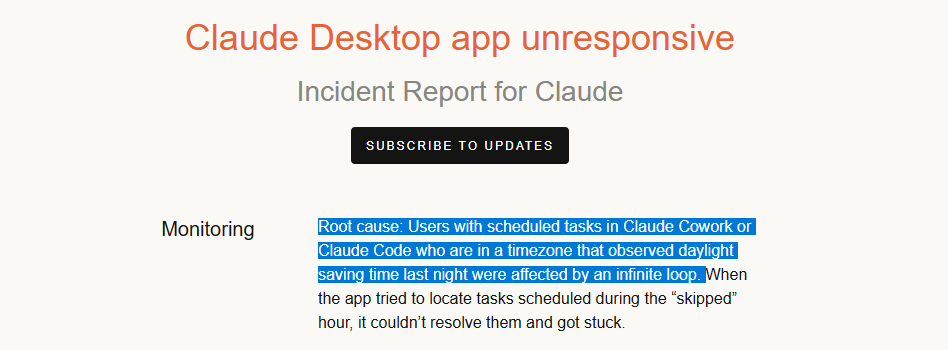
The above video wandered into my feed and it's talk about how in this October there will be a vote in the CGPM as to the exact fate of the leap second. Recall that in 2022, the CGPM decided that "by 2035, the maximum difference between UT1-UTC will be increased" from the existing 1 second threshold. A resolution is supposed to be drafted for the 2026 CGPM meeting as to what to do. Essentially, 2022 set off the important procedural work needed to get a bunch of scientists and international bodies to align on what we were going to do with leap seconds, and now we get to see the results.
As a brief flashback UT1 is basically tied to the sun, UTC is tied to atomic clocks, and as the earth's rotation speed changes, the difference between the two changes. The difference is currently not allowed to be more than a whole second, and leap seconds are injected (or removed) from UTC to fix the difference. See my many posts about time for details.
So this video is a presentation at a conference with the aim of sharing current understanding as well as a form of generating support in all the member states of the CGPM for the formal vote in a few weeks time.
What caught my attention in the presentation is that the speaker went into a bunch of details about what they were trying to figure out. What is the probability that the Earth could experience a negative leap second by 2035, the time the CGPM -2022 resolution gave to determining what to do with the leap second. The implication is that if there was no chance at all of a negative leap second, then the decision didn't have as much urgency to it relative to if there was a a chance we would need a negative leap second and all the technological uncertainty that brings.
To skip to the punchline, all these folks got together and developed a model that estimated that there was a roughly 30% chance that we would see a leap second by 2035, and roughly 50% chance that we would see a normal leap second. Either way, the risk is sufficiently large enough that they want to move the timeline on eliminating the leap second quickly.
So what's been causing all this?
Since the 2022 resolution, people from multiple fields have studied the problem. Agnew's "A global timekeeping problem postponed by global warming" in Nature (2024) had come to the conclusion that the core of Earth had been contributing to the increase in speed of the Earth's rotation significantly and global warming's melting of the ice caps had actually served to slow that increase. That said, that paper mentioned that a negative leap second may have been necessary as early as 2029.
Then, in 2025, there was a "CCTF-IERS Workshop on negative leap second" which a bunch of experts from various fields to get together and share there various independent methods for trying to predict the leap second. There are 9 slide decks from different teams all tackling the problem from the lens of their own area of expertise, whether it's geophysical processes, astronomical observations, or statistical models.
What's most interesting to me is that you can sift through the sildes, which are barely intelligible (if that) to someone outside the field and get a rough idea of what they were doing. For one thing, I've been wanting to know what experts think the main causes of the speed-up has been for years but couldn't really pin it down since it's buried in unfamiliar literature.
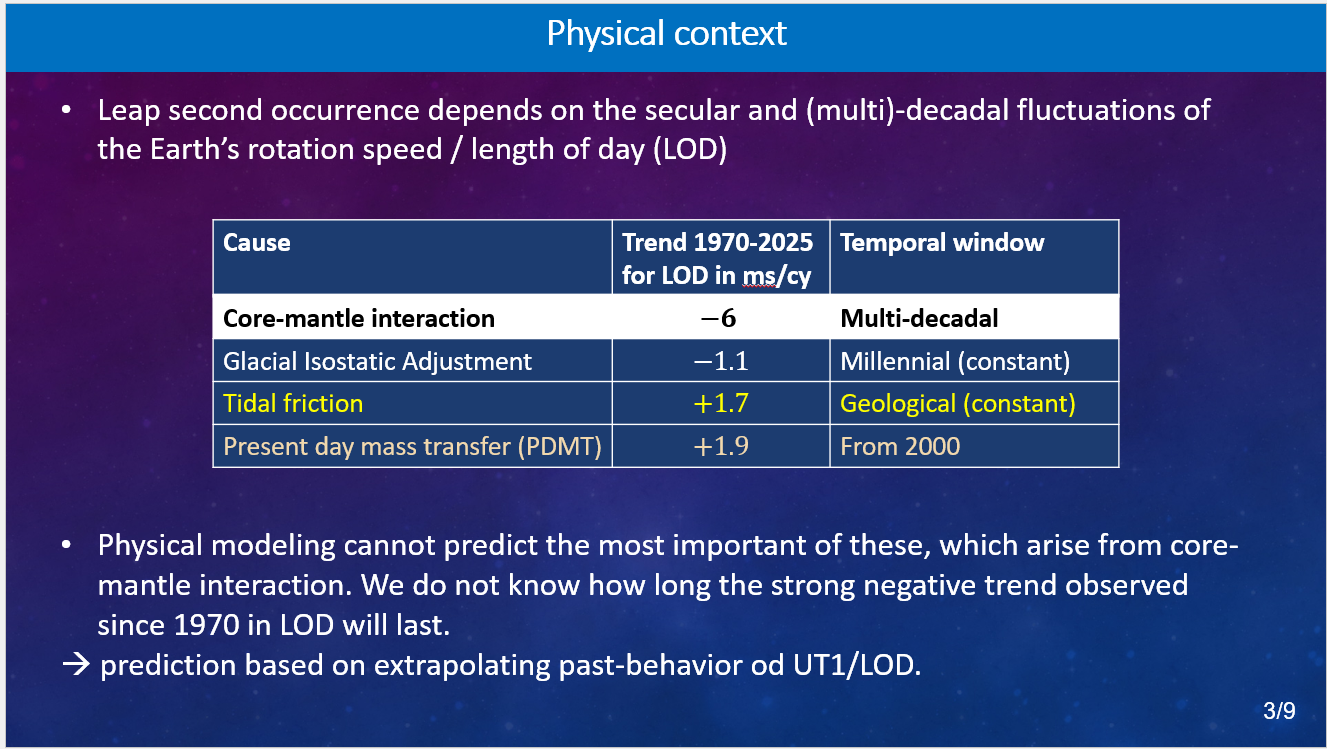
What's cool about this slide is that it shows how the core-mantle interaction is the dominant speeding up factor in the whole mess, estimated at about -6ms/cy. The change in LOD of -6ms per century sounds like a tiny change, and it took me a while to figure out what it means.
The Length of Day (LOD) in solar time (aka, the time it takes for the Sun, or a fixed point distant star passes directly through the same point overhead) is slightly off from the SI atomic definition of 86,400 seconds in a day. That tiny difference between LOD and atomic time, positive and negative, gets added up over time and when that sum gets too big we get a leap second. But the "trend in LOD" in the slide is talking about how, over time, every century, the difference between LOD and atomic time is changing. So it's an acceleration term, and thus if you take the integral of the difference between LOD and atomic time, you get a quadratic growth in accumulated seconds of "leap second debt".
From the slide you can see that the mantle interact is on a "multi-decadal" time window, meaning that over decades its contribution to the LOD change gets bigger over smaller. There seems to be a 60-70 year cycle of the Earth's core speeding up/slowing down that interacts with the mantle and even the Earth's magnetic fields to power an effect where the core oscillates in speed. (Here's a Youtube video that walks through a bunch of references on the topic.)
Meanwhile, everything else is essentially contributing minutely to slowing things down over the long term.
What happens next?
So the CGPM is meeting on October 13-15th and will have a vote on a resolution to change how leap seconds are handled so that UT1-UTC will not be 1 second, but 3600 seconds (1 hour). Effectively the notion of leap seconds will be kicked down the road for many centuries and people will theoretically reset their clocks like a daylight savings change.
You can find the draft of the resolution about UTC here.
If the resolution passes, and people seem to think it will, then a lot of bodies that deal with leap seconds are prepared to act. the IERS will be adjusting the procedure for how they (won't) announce leap seconds, the ITU will adapt their protocols and signal codes for how time is transmitted, for example via radio. The proposed application date will be May 20, 2027, "World Metrology Day" celebrating the initial signing of the Metre convention and the adoption of SI units when all SI unit changes usually go into effect.
Day 3 of the CGPM, so the 15th, will have a presentations on the leap second issue, as well as a proposal for a new definition of the second. There's supposed to be live streams of those sessions (and other sessions in the prior days). So in case you just want to be extra nerdy, there's always that option.
Either way, voting on the resolutions happens offline at the end of the third day and the results via press releases soon after.
Standing offer: If you created something and would like me to review or share it w/ the data community — just email me by replying to the newsletter emails.
Guest posts: If you’re interested in writing something, a data-related post to either show off work, share an experience, or want help coming up with a topic, please contact me. You don’t need any special credentials or credibility to do so.
"Data People Writing Stuff" webring: Welcomes anyone with a personal site/blog/newsletter/book/etc that is relevant to the data community.
Counting Stuff Official Forums: Discuss posts, or other data topics with the community.
About this newsletter
I’m Randy Au, Quantitative UX researcher, former data analyst, and general-purpose data and tech nerd. Counting Stuff is a weekly newsletter about the less-than-sexy aspects of data science, UX research and tech. With some excursions into other fun topics.
All photos/drawings used are taken/created by Randy unless otherwise credited.
Supporting the newsletter
All Tuesday posts to Counting Stuff are always free. The newsletter is self hosted. Support from subscribers is what makes everything possible. If you love the content, consider doing any of the following ways to support the newsletter:
- Consider a paid subscription – the self-hosted server/email infra is 100% funded via subscriptions, get access to the subscriber's area in the top nav of the site too
- Send a one time tip (feel free to change the amount)
- Join the Approaching Significance Discord — where data folk hang out and can talk a bit about data, and a bit about everything else. Randy moderates the discord. We keep a chill vibe.
- Get merch! If shirts and stickers are more your style — There’s a survivorship bias shirt!