
Farewell, leap seconds
The vote at the CGPM last week has made it official, as of May 20, 2027, leap seconds will no longer be added, and the difference between UTC (atomic time) and UT1 (astronomical time) will be allowed to differ by as much as 3600 seconds (an hour) instead of the previous 1 second.


The resolution noted that the researchers have determined there's about a 30% chance of a negative leap second, which absolutely no one wants to see happen, and that was one of the main contributors for why they're doing this quickly.
Since leap seconds are announced about six months in advance, any leap second that would have been applied between now and May 20 would have had to have been announced around July, so the last leap second for our lifetimes happened on December 31, 2016. Given that throughout the history of the leap second from 1972 until 2016, there had been only 37 leap seconds added, the majority early on, accumulating 3600, it will likely take millennia before UTC-UT1 hits the 3600 second threshold.
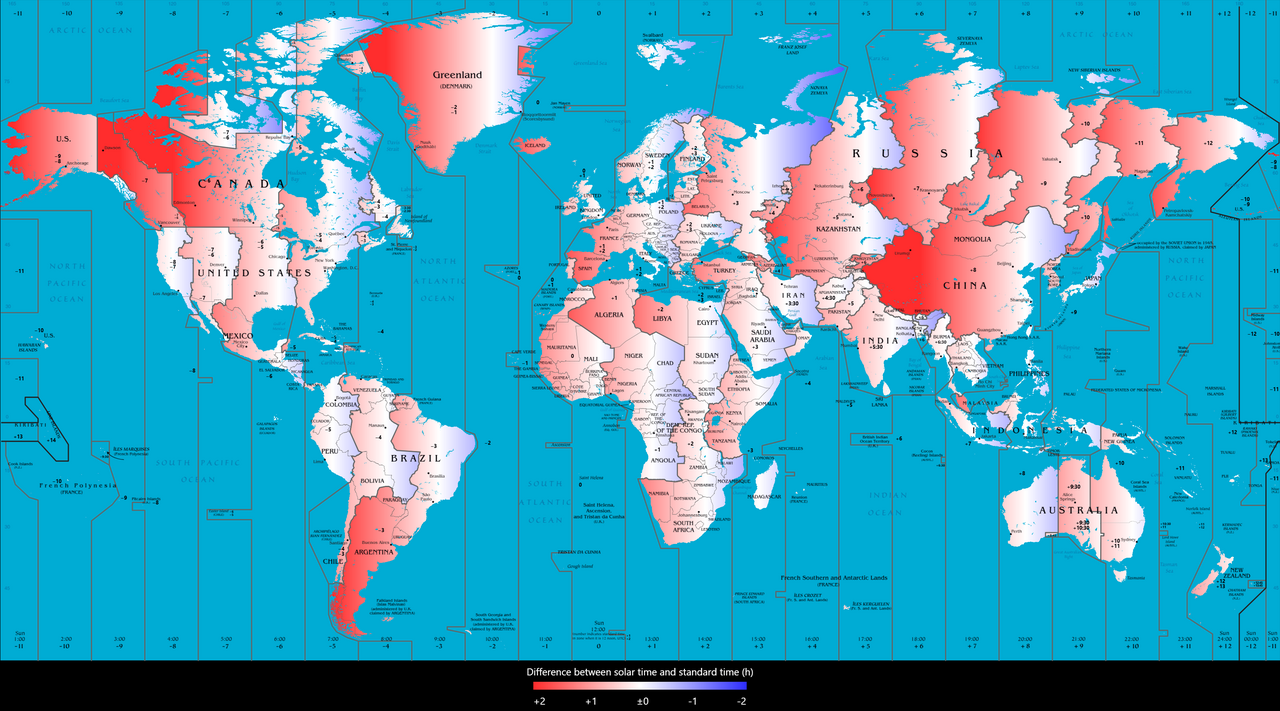
Some people will wonder why is 1 hour difference acceptable, and at a high level, the explanation seems to be "because people are pretty used to living with ~1hour gaps between solar and standard time". As you can see in the image below, large chunks of land area live with significant shifts from their local time versus the sun already. Moreover, many people are regularly subjected to 1-hour discontinuous jumps thanks to daylight savings/summer time conventions. The thinking goes that a future "leap hour" can simply be treated like a global time zone adjustment that our future computers will likely be able to handle.

Regardless, this is a problem that is literally many generations ahead of us. Who knows what civilization, or clocks, will be like then.
Lunar time will come (someday)!
So, I'll dedicate a full post to this topic in the future once I study it. It's really complicated, but Resolution 6 is about the process of establishing the standards for Lunar time standards!


The gist of it here is that the the International Astronomical Union (IAU) has a theoretical framework developed that allows time standards to be translated from an Earth reference point, to a solar system barycenter reference point, and finally a Lunar reference point. In the end there would be a way to convert clock readings on Earth with those on the Moon. Since we're talking about atomic clock references, the clock accuracies are such that every little detail involves relativistic effects, so clock references have to be defined with respect to a gravitational field (hence reference frames for Earth, Moon, and Solar System (aka Sun)).
The resolution is one of the first steps in the process of coming to a standard for how to do this. At a high level, my reading of it is "We, the CGPM, have determined that the IAU's framework for handling lunar and solar system time is the best theoretical way of doing things thus far, all member states should work under that framework when you're doing space missions and report back to the committee the practical implementation details you all face in realizing time on the moon". Eventually those experiences and models will contribute to some final time translation standard. This is a process that will take many years and multiple CGPM meetings (which meets every four years) to finalize. So I guess it's something to look forward to?
What, just me?