
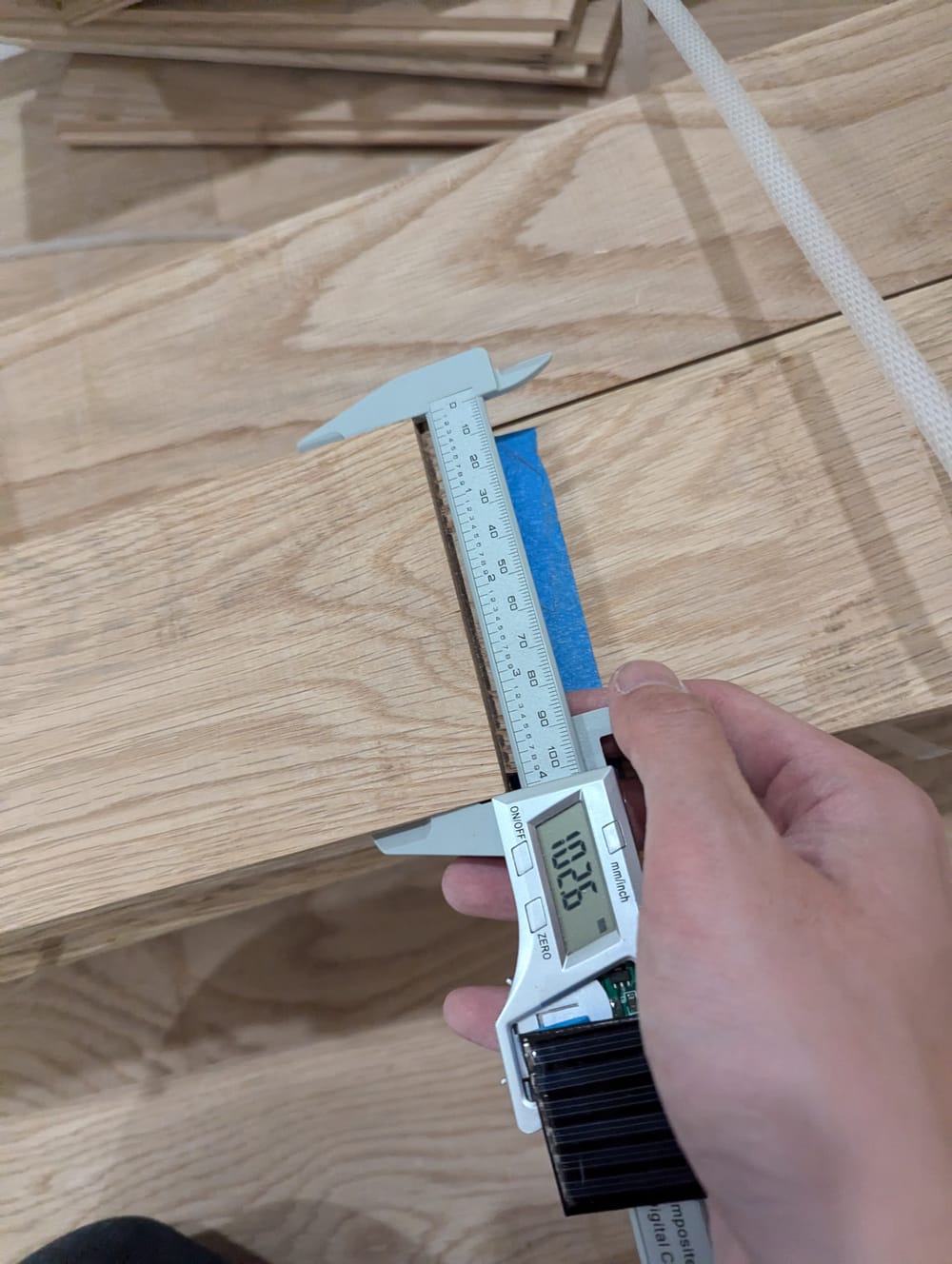
Measuring stuff in practice, wood floor edition
Hopefully this explains why I've been mostly writing the past couple of posts primarily from my phone.
Camping in a literal construction zone just to be able to send the kid off to school is no fun. What's even less fun is learning that the flooring that we ordered had, likely due to natural moisture related movement, changed in width with a max variation of up to 1.5 millimeters from least to most wide boards, so an error of almost +/- 0.8mm. Considering that the original certification spec is within +/- 0.2mm of the nominal width when coming straight off the factory line, that's 4 times the variation.
We first learned of this issue when our floor installer was setting the first couple of rows of wood and there were noticeable gaps between boards where one board was less wide than its neighbor. Because our darned eyes are so sensitive, the gaps are visible without much effort. Best we can do now is use some wood filler patch it before finishing.

The error seems to be random across all the boards due to the interaction between how the trees grow and how the wood expands/contracts due to moisture content. The frustrating thing is that the warping affects every piece of wood randomly unevenly across the entire length. Depending on the wood's structure, the ends might expand a bit more, or the center, or a little of everything. White oak is also a pretty hard wood, so even a really firm smack with a mallet doesn't compress it enough to get rid of most of the gaps.
Since I'm not able to return the wood, I've got to make do with what I've got. How do we mitigate the worst of this? By sorting the wood into collections that are similar to each other. So long as every ROW of wood gets laid down next to similar-sized ones, things should work out.
And this is the stage for today's practical measuring story.
Most of you know that I've got a thing for collecting measuring devices, so I'm sure you'd expect me to break out a set of calipers or maybe even a micrometer to measure all the wood and bin them according to size. Well, it's true that I did dig out my calipers later in order to understand what was going on with the wood (manufacturing flaw or something else). But I wasn't going to measure every single plank of flooring with calipers. That'd take a huge amount of time and effort because at that level of accuracy holding the tool slightly off changes the measurement a ton. Instead, I took advantage of some back of the envelope guesses about statistics and human touch to work at a much faster (but still painful) pace.
The first step was to find two relatively short pieces of wood (for portability) that strongly differed in sizes. My guess was that if I divided the planks into groups that more closely matched the two arbitrary distant points I picked, then the boards in each group would tend to have more similar widths and work better together. There'd still be variation within each of the two groups, especially if the ends change size independently, but the SD should be much closer to the +/- 0.2mm spec instead of +/- 0.8mm. If we can get things to within a few tenths of a millimeter, then hammering things tightly stands a better chance of squeezing out imperfections.
Did you know that the internet says there are studies that show that a person can use their finger to feel difference in surface heights as tiny as 13 nanometers? Our sense of touch is ridiculously impressive even if I'm unable to reach whatever pinnacle of sensory ability 13nm represents. With this knowledge in my head, I knew that I could line up two boards and tell to what degree they're the same width by feel alone. Effectively I used two boards to create very simple go/no-go gauges that would tell me which pile of wood a given plank belonged to. All that remains is then manually comparing every single plank against my two gauges.

It seems to be working? I won't know definitively until we start nailing down planks again. When I randomly try to line up planks from the same piles together, there's less noticable variation. There's still the problem of both ends bot being the same width but there's not much to do about that unless I obsessively separate everything based on measuring both ends.
What surprised me was that I later took calipers to my gauge boards and they measured 101.9mm and 102.6mm, a mere 0.7mm difference. But as I worked I found I could compare a plank against board A, and just know from the feeling that it would a good fit for board B.
The vast majority of boards came closer to the 102.6mm measurement. I'd guess 70% of the stacks so far. Then about 25% agreed with the smaller 101.9mm reference. The remainder fell into a third "weirdly sized" pile that had pieces come in at slightly above 103mm that maybe I can use for the closets where gaps don't matter.
Interestingly, this setup is very similar to how tooling and machine shops work. The very expensive and accurate tools are used as calibration references in the main office, but a cheaper set of tools like these go/no-go blocks are used on the workshop floor because they're so much faster to use and cheaper to replace. Over repeated use, the set of tools on the floor wear out and need checking against the accurate reference tools. In fact I'm pretty sure my finger is slowly wearing away at the corners of my reference boards.
Another thing this process highlights is how good measurement is about good procedure. Using calipers to measure the boards gives very precise numbers, but to do it consistently you need to put the jaws of the calipers in a certain way, and you have to measure it square to the work. You can't even press too hard or else it will deform the wood or caliper. So simplifying the process down to "do these feel the same width? Yes/no." Eliminates a lot of the thinking and work.
Anyways, as you can see, measurement with real world working constraints is different from abstract measurements on computers. It's hard to express in exact millimeter terms what feels to my fingers as being 'close enough' without a lot more thinking about tolerances and measurement errors. It's work that would slow this already unwanted project even more.
So we work with what I've got, and I'm gonna go buy a 14lb bag of wood filler to cover what I can't mitigate.
Standing offer: If you created something and would like me to review or share it w/ the data community — just email me by replying to the newsletter emails.
Guest posts: If you’re interested in writing something a data-related post to either show off work, share an experience, or need help coming up with a topic, please contact me. You don’t need any special credentials or credibility to do so.
About this newsletter
I’m Randy Au, Quantitative UX researcher, former data analyst, and general-purpose data and tech nerd. Counting Stuff is a weekly newsletter about the less-than-sexy aspects of data science, UX research and tech. With some excursions into other fun topics.
All photos/drawings used are taken/created by Randy unless otherwise credited.
- randyau.com — Curated archive of evergreen posts. Under re-construction thanks to *waves at everything
Supporting the newsletter
All Tuesday posts to Counting Stuff are always free. The newsletter is self hosted, so support from subscribers is what makes everything possible. If you love the content, consider doing any of the following ways to support the newsletter:
- Consider a paid subscription – the self-hosted server/email infra is 100% funded via subscriptions
- Share posts you like with other people!
- Join the Approaching Significance Discord — where data folk hang out and can talk a bit about data, and a bit about everything else. Randy moderates the discord. We keep a chill vibe.
- Get merch! If shirts and stickers are more your style — There’s a survivorship bias shirt!