
How to have way too many hobbies too!
Thanks subscribers for always supporting this newsletter. Y'all literally pay the server bills that keeps things going. For those who're more new, these semi-regular Thursday posts are much more about whatever's floating in my mind and they can be "on topic", or complete excursions like this week.
It's been a long week (yes, I know I'm writing this on a Wednesday night). It's also been a long time since I have run off on a wild, meaty tangent. So I figure this week I'll answer a question I get pretty much every time the full scope of my "side projects" run. How the heck does one even accumulate close to a dozen hobbies?
Disclaimer: A solid chunk of this is probably correlated to neurospiciness. I'm 100% certain what I'm doing isn't typical in any sense, but surely the core fundamentals can be useful to at least see laid out in plain view.
Since I can't untangle my experiences from what works for me, here's my best attempt at laying out the chaos that goes on in my head.
Obviously, start from an interest
Despite the obviousness, it does bear repeating that any hobby is done in your spare time for your own enjoyment and interest. You're allowed to start, and stop, one at any point for any reason. Ideally if you do things right, you won't feel too much guilt or regret for dropping a hobby either – meaning you don't pour too much money and time into something you're not sure about yet.
Much as I have a bunch of hobbies that I've grown decently good at, like for example translation or modeling 3d prints, I have plenty of hobbies that don't "make it". As an example, I have a set of lockpicks and practice locks but am still pretty bad at locksport. I'm also very terrible at music creation despite making another honest attempt and/or buying gear every year or so. I've got a stack of leather scraps in a box but I still haven't put together that wallet I've been planning on making for about 5 years. Maybe my new-to-me vintage sewing machine will be useful... or maybe not.
I use the word "Interest" in a very broad sense. Overall I like making stuff, especially tangible stuff that fulfills a need that I either can't fulfil with retail goods (because I'm picky) or because of cost (I can't afford to collect $$$$$ pretty gemstones).
I started woodworking with hand planes because I wanted to make some stuff, didn't have room for big scary power tools, and there's lots of great YouTubers who teach the more traditional methods. I started translation because I really like video games, wanted to read ones that never got ported over in the 90s, and one thing led to another and somehow people started paying me to do translations. I started learning how to cut gems because right before the 2019 COVID lockdowns, I was watching videos on how people did it and "hey, that doesn't look so hard but seems really really cool!".
I'm sure everyone has at least one or two things they enjoy and go deep on. The question is, how can someone who wants more hobbies (because of the new experiences involved) snowball things to the point of ridiculousness.
Snowballing – things transfer
Every hobby requires three things – interest, skills, and usually equipment/tools. Each of these can transfer to other hobbies with a bit of creative stretching.
No one is particularly surprised that someone who's interested in cooking may become interested in making things from scratch. From there it's not too much of a leap to learning how to ferment many delicious foods. And from there, it's not too far of a conceptual leap to consider learning how to ferment alcohol. You can stretch even further down less obvious paths. For example, being interested in listening to music and audio equipment very quickly leads you towards learning bits of electronics if you go down the DIY/modification route. There's no controlling for interest other than whatever your heart wills.
But the more interesting things are skill and tool transfer, because in my experience, they transfer a LOT.
When I'm pondering if I want to embark on a new hobby because I feel like I want to make something that I can't quite do just with my current abilities, I start looking at things where I'm a little bit familiar with some of the work. If you know how to sharpen your kitchen knives by hand, sharpening woodworking tools is identical. If you know the theory of using progressive grits to bring a blade to a mirror shine, that exact same theory applies to rocks.
The trick is to be very expansive in how your preexisting skills can be applied. We all live in a single world and many things are interconnected in interesting ways. Understanding and maintaining the mechanicals of a bicycle are surprisingly not that much different than the mechanicals of a sewing machine – bits of metal move around in precise ways and need lubrication. You wouldn't expect there to be any real overlap but they're both very straightforward machines that work identical principles. If you know how to read musical notation, hold a beat, and listen for pitch with one instrument, learning a second is much easier than the first time around.
The same also goes for tools. I've built a very well rounded set of equipment because I'd do my best to focus on tools that can be used to do more than one specialized thing unless it was absolutely necessary. Nowadays, I can reach for calipers and micrometers whenever I need to be precise in my 3d priting designs. I can pull out my mini kitchen butane torch to make some creme brule or silver solder a jewelry joint. My big power miter saw lets me square off bits of wood to make simple wood or aluminum pieces of consistent length for all sorts of random tasks. All the little pliers I have to bend jewelry wire is also great for bending other small bits of metal like zipper repairs.
Lots of "outside study"
This is the spicy bits talking, but I binge consume hobby content. YouTube hobby channels of people just showing and talking out loud about what they're doing can eat up huge chunks of my time. I also love reading a bunch to learn what people in the hobby think is good or bad. I tend to do this long before I decide to pull the trigger and actually start buying supplies and equipment to start a new project, so through exposure and osmosis I've picked up at least a thing or two already. I find this whole process enjoyable so it doesn't really feel like work. We're lucky to live in an age where there's endless content being created on any skill or hobby you can dream of. Beginner friendly content is the most monetized thing around so people are incentivized to show you the basics of everything.
And once you get an idea of the basics, it's usually not too hard to find experienced practitioners "doing their thing", so the opportunities to watch and pick up things is always available if you care to look. Again, I doubt there's ever been a point in history where you could peek over the shoulder of an expert, for free, on demand, from the comfort of your pajamas.
Enjoying useful practice
You can only get better at something by practicing and messing up. Usually that means making scrap work because you need to get used to the physical motions of drawing a violin bow, sawing a piece of wood straight, or soldering something without melting the components. While that's all and good, hobbies need precious time away from adulting, so it doesn't feel good to do a lot of practice without some tangible results at the end.
So I just learn to live with my ugly mistakes. One of the first "big" pieces of wood furniture-like things I made was this... thing. Technically it's a shin-high mini balance beam/bench-like thing. The reason I needed it was our child was learning to stand and I wanted something their height that they could hold. I didn't even have my miter saw yet so I had to cut these angles by hand using an old school plastic miter box. Clearly, I was not very good at it.
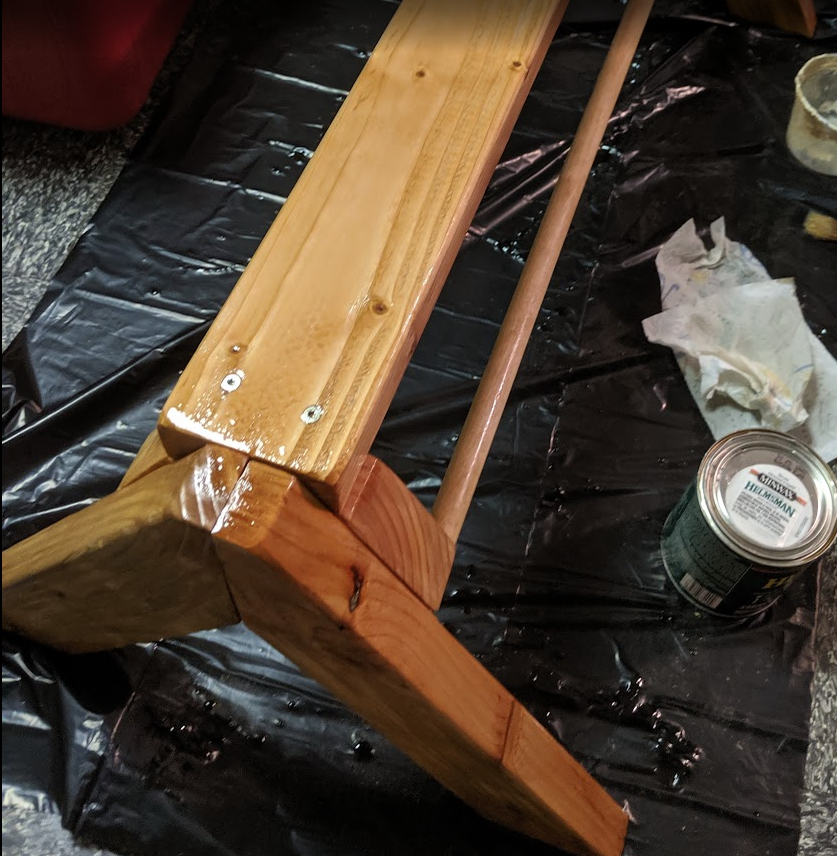
Despite how crooked everything looked, how poor the design was, the whole thing was solid enough and worked. I didn't have to throw anything out, and got some practice out of it. Along the way I learned that I should really get that power miter saw because I don't have the time to learn to cut angles properly. The utility shelves I threw together at a later time were much better from those lessons.
If you keep practicing on these "for me only" type projects, you get better and better. I did that for translation for a couple of years and eventually got into doing that work as a fan, then finally got paid to do projects, all from steadily practicing on things I wanted to work on.
Focus on multi-purpose tooling
One of the lessons from an old cooking show I liked, Good Eats, was that the only "unitasker" tool in the kitchen should be the fire extinguisher. Everything else can, and should be things that can be used to do more than one task. Rolling pins can work dough or flatten or pound other things, various gadgets are only good if you can do more than one thing with them. That whole philosophy left an impression on my younger self because I apply that for most tool purchases.
When I consider buying some relatively expensive tool, like "do I really want that $150 vacuum pot?" I can consider whether I have a current use for it in my existing hobbies (mostly soaking leather pieces in oils and stuff) versus new hobby stuff (resin casting). In this case, those options looked uninteresting, so I never got the vacuum pot. Meanwhile, I bought a flex shaft motor tool because at the time I wanted to learn how to power carve wood, AND I also wanted to use the standard jeweler's bits to cut/carve/polish all sorts of tiny things.
While sometimes you can't avoid a specialist tool (there's not many alternative uses for a gem cutting machine), you at least know up front that they're special purpose and you better not buy something you'll regret later.
The unexpected end result of snowballing tools for 15 years is that when I want to do something, I often have something that can get most jobs done now. I still want new tools to do new things (every few weeks I keep daydreaming about a lathe) but I've covered most of the things I want to fabricate.
Enjoy being bad at something
A lot of my little projects I post are hilariously low quality because they're obviously the work of a first timer. But it's nice to just do things without worrying about doing things right. So I find it's a lot better for me to just laugh and celebrate improving as I fumble along. Early improvements always come pretty quickly since there's always so much you don't know, every attempt can be an improvement. The thing to actually be careful of is the inevitable hump at intermediate level where you suddenly have to put a lot more thought and energy to get further improvements.
Anyways, this is the weird philosophy in my head when I run amok with my hobbies. Having a brain that loves absorbing this stuff just means I take it to extremes, but I do sincerely believe that I'm not doing anything outlandish. Right?