
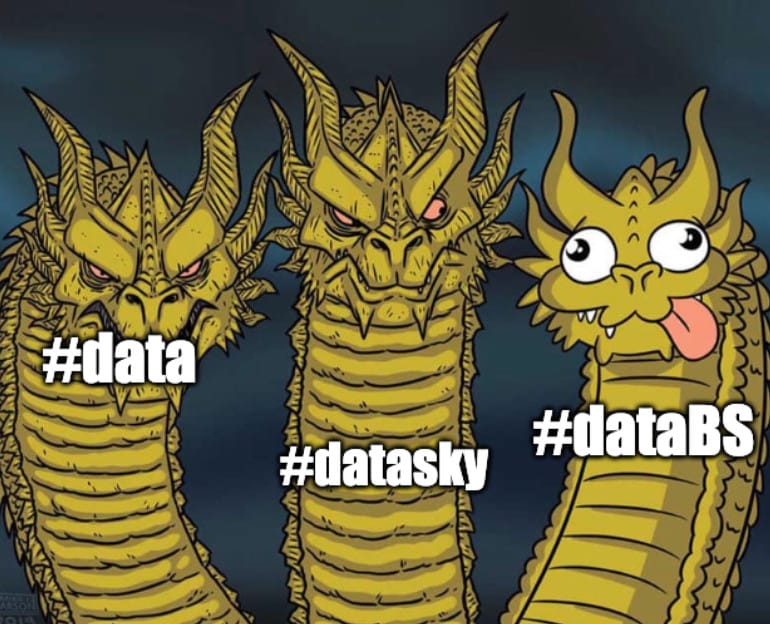
We're all the #dataBS, but individually not
This week is about community and shared spaces. Next week, if things work out, I'll finally finish a book review I've been slowly chipping at in between hours of frantic packing. Also, if you're in the US, can but haven't yet voted, vote.
Data Twitter is dead. Long live Data Bluesky until it too eventually dies in the far future. There's already been multiple people who have written about how they're finding the community that's forming on Bluesky to be the thing they've been missing since the old Twitter days. I won't rehash all their many valid points. Instead, I want to put out a shout of encouragement to everyone here to join, and be an example of the community that we all want to see.
"Data Bluesky" is long and awkward to type, and so last week while wrapping up my pitch to readers about the wave of migration, my brain landed on #dataBS. I sorta mentioned it on a few times on Bluesky itself and other people generally liked it and started using it? So I think at least some? most? of the blame goes on me for getting the tag started.
Currently, a decent number of people have adopted the tongue-in-cheek hashtag. I've also seen people use #datasky (a lot of group hashtags on there use -sky suffixes) and #data. I've also seen some people feel hesitant about using such a tag, if not openly opposed to it.
My view on the current hashtag situation is pretty simple: everyone should use the hashtag they want! Be the community member you want to interact with! There's a feed now that will include chatter from #dataBS, #databs, and #datasky so honestly if you use something people are going to see it. Or let another one take root. Go wild!
As an aside, I also find it funny that various people have noticed that #dataBS can not only be read as data BlueSky or data bullshit, but also "da tabs" (Northeast accent preferred). It definitely contains multitudes.
Be an example of the community you want to be in
As a geriatric millennial, I've seen my fair share of platforms blowing up and taking my preferred community of the time with them while we scrambled to rebuild somewhere else. Eventually you get to see the broader patterns in how things shake out.
From that perspective, right this very moment, we are in the process of building norms in the new place. It is a messy process where no single person is able to control or dictate where things will go, just like no single grain of sand is itself an avalanche. It is always the collected, averaged behaviors and practices that dictate what the norms are. Norms form because members of the community visibly practice the norms so that other members (and new members) see that this is how we are supposed to behave. Norms fade away when people stop visibly enforcing the norm. This is true whether it's the practice of asking and answering questions nicely, or shouting down jerks.
A lot of what made Data Twitter so wonderful to many was that we had an active community of people who all followed each other in a giant, dense ball that didn't even bother to use any hashtags. They'd trade jokes, advice, questions, answers, and resources constantly for the world to see. They'd also welcome anyone who wanted to engage and let them join the ball. Those patterns of behavior just kept repeating and repeating until it became a resource we all loved.
Now, in the ongoing transition to Bluesky, we're seeing similar, but probably not identical patterns of behavior popping up. There is a grand mix of both old faces and new. We're currently chatting up a storm in the usual mix of serious and not-serious posts. Cool things are being shared, questions are being answered, memes are pretty rampant. The hope is that ongoing engagement will turn all the positive parts into norms that can self-reinforce going forward.
So while we're in this phase, I can't emphasize this enough. We ALL are part of this forming community, and it's up to us, individually, to engage with the community in the way that we want others to engage with it. Because by acting out what we think the norms should be, we're adding our little grain of said to the pile of collective "This is how things are".
One thing to remember is that Internet communities are surprisingly fragile creatures. Knock out a handful of the most visible members who were good at exemplifying the norms and the norms can wither away in an eyeblink. So don't rely on single points of failure! Build in resilience to the network by interacting with everyone big or small!
What the data-on-bluesky community means to me
Here's what #dataBS means to me, and what I actively try to project as the community I want to be in. Maybe you'll agree, and maybe not. Either way, this is how I choose to throw my grains of sand into the communal pile. You do with yours as you see fit.
1 - We don't take ourselves too seriously
In my view, #dataBS perfectly captures the spirit of the data community I want to be in precisely because it is an irreverent, cheeky, self-deprecating joke. It clearly shouts out that we're not taking ourselves too seriously here because all of us damn well know what that tag looks like. We're here to have fun on top of the many other reasons to be here.
Yes, there are lots of folks working in data doing serious, noble, data work on projects that are literally trying to cure cancer, mitigate life threatening disasters, or otherwise advocate for truth and justice. I've had plenty of serious, thoughtful conversation about data topics the past few weeks (I was in one this morning about ACCOUNTING!) and it's been great.
But many more of us work on data things that are. if not fictional delusions of the tech world, at least significantly less serious and sometimes bordering on nonsense – clicks on ads, cryptocurrency, line graphs of total users for a board meeting. On some level many of us know how silly some of the work is. Even the folks working on ostensibly "serious stuff" have silly moments in their line of work too. We might as well celebrate the silliness and find joy in connecting over it. This is evidenced by the popularity of various memes and jokes in the community.
Anyways, my posts on Bluesky tend to be short jokes and cheeky comments because I find it amusing, and it's a way to keep myself grounded after a long day of counting things. I have this newsletter to let my more nuanced serious thoughts out.
2- We welcome just about anyone
The data "field" attracts and welcomes people across practically every industry and field of study in existence. The act of counting things that matter and analyzing them with mathematical methods to learn something is so utterly fundamental in modern society that everyone who has an interest in joining our community has always been greeted with open arms.
Most of us don't have credentials aside from teaching ourselves and seeing some horrors. While it might take extremely advanced knowledge and tools to measure certain things (Hi, CERN!), a child could take detailed measurements with a thermometer and probably be able to make a meaningful contribution to some dataset somewhere. If everyone's potentially a new member, gatekeeping is a futile exercise in snobbery and I'm very happy that most people in the community recognize that fact.
My theory is that when you have such a hugely diverse group of people, the most fundamental common bond between us all is the shared pains and foibles and sheer silliness that comes from having to count things for a living. The most towering minds of AI, the researchers cracking the genetic code of a virus, the astronomers looking at light from the edge of the visible universe, they all have stories about that one stupid missing comma that took them an hour to debug, just like the student running their first Jupyter notebook. Talk to any number of smart people in the community and you'll very quickly realize that we're all just humans doing our best, often making things up as we go along.
And so I've always engaged with everyone I see in the community as more or less equals. If a person, any person, is asking a question, then answer it helpfully or share to see if anyone else can help. If someone posts something cool, share it and express support. If someone's being a jerk or a gatekeeper, point that crap out and block. I'll also make a point to show the various dumb things I do in public too because I do plenty of them, and it's good to normalize that making mistakes is normal.
3- We're people, not one-dimensional personas
The welcoming aspect about the data community doesn't just stop at "being data people". Everyone has some nonzero degree of comfort in sharing bits about themselves that have nothing to do with data, and people are happy to take joy in those aspects too. We'll post about our latest hobby creation, a neat book we love, a video game we just got a sick achievement for, or a rad new piece of gear for hiking, biking, or whatever. I personally loved watching one person make guitars, a group of people make photos and art, someone show off their bee hives, and others chatter on about sports and politics.
This aspect is probably one reason why data folk were so unsettled with the shift to LinkedIn as the refuge of last resort the past few years. The people who regularly used LinkedIn are notoriously one dimensional about their "personal brand". The algorithms there encourage projecting the same persona all the time.
But we're not personas, we're actual people with loves, hates and depth. Plus, it's really really hard to put yourself in a vulnerable spot and ask a question in public if you're not comfortable with interacting with the people you're exposing your vulnerability to. Seeing some expert that you respect being also a fan of the same thing you're in just makes them all the more approachable.
So in the same way I enjoy seeing people talk about whatever brings them joy, I always talk about the stuff I love too. And I make a point to encourage anyone I see doing cool stuff to do more of it – mostly because I want to straight up want to see more of it, but also in the hopes encourages them to do it more for other things too.
Whatever you do, enjoy the community
Hopefully I've helped convince you that you can be a contributing member of the community by doing as little as hitting a little heart button without further comment. None of this takes past experience, credentials, or special skills.
But even if you choose not to directly converse or interact, enjoy seeing all the other people doing so. One day in the future, I'm sure you'll find the perfect topic to jump in.
Standing offer: If you created something and would like me to review or share it w/ the data community — just email me by replying to the newsletter emails.
Guest posts: If you’re interested in writing something, a data-related post to either show off work, share an experience, or want help coming up with a topic, please contact me. You don’t need any special credentials or credibility to do so.
"Data People Writing Stuff" webring: Welcomes anyone with a personal site/blog/newsletter/book/etc that is relevant to the data community.
About this newsletter
I’m Randy Au, Quantitative UX researcher, former data analyst, and general-purpose data and tech nerd. Counting Stuff is a weekly newsletter about the less-than-sexy aspects of data science, UX research and tech. With some excursions into other fun topics.
All photos/drawings used are taken/created by Randy unless otherwise credited.
- randyau.com — Curated archive of evergreen posts. Under re-construction thanks to *waves at everything
Supporting the newsletter
All Tuesday posts to Counting Stuff are always free. The newsletter is self hosted. Support from subscribers is what makes everything possible. If you love the content, consider doing any of the following ways to support the newsletter:
- Consider a paid subscription – the self-hosted server/email infra is 100% funded via subscriptions
- Send a one time tip (feel free to change the amount)
- Share posts you like with other people!
- Join the Approaching Significance Discord — where data folk hang out and can talk a bit about data, and a bit about everything else. Randy moderates the discord. We keep a chill vibe.
- Get merch! If shirts and stickers are more your style — There’s a survivorship bias shirt!