Going back from carats to carobs
OMG time is FLYING. And I'm currently knocked out from a cold the kid brought home from school. But for DataBS Conf, two things: One, the official schedule is out. Two, get your tickets! It's Happening NEXT WEEK! *panic
If you have any fascination with shiny polished rocks, you've probably heard of the carat unit. The modern metric definition of the carat is pretty simple, 1 carat = 200mg . Prior to the metric version, various standards in more recent history would put it at around 205mg. And in the Roman times, the carob seed gave its name to the 'siliqua' coin, but in their weight system historians have estimated that a single seed was around 0.19 grams.
You've also probably heard the story that the carat was defined based off the seed of the carob tree because the seeds were of such consistent weight that people since ancient times used them as a standard of measure for precious metals and especially gemstones. In fact a lot of other much older measurements derive from the weight of seeds – for example the grain is by definition as of 1959 as 64.79891 mg, and was based on a single grain of barley, which is roughly 4/3 the weight of a single grain of wheat. Tradition apparently held that 1 carob seed was equal to 4 wheat grains and 3 barleycorns.
So, one day out of boredom or inspiration, I happened to check to see how much it would cost to buy some carob so that I could handle the seeds myself. I was really suspicious as to whether the carob seed as consistent as the stories say. And so, by the power of ebay I bought a small bag of carob pods from California!

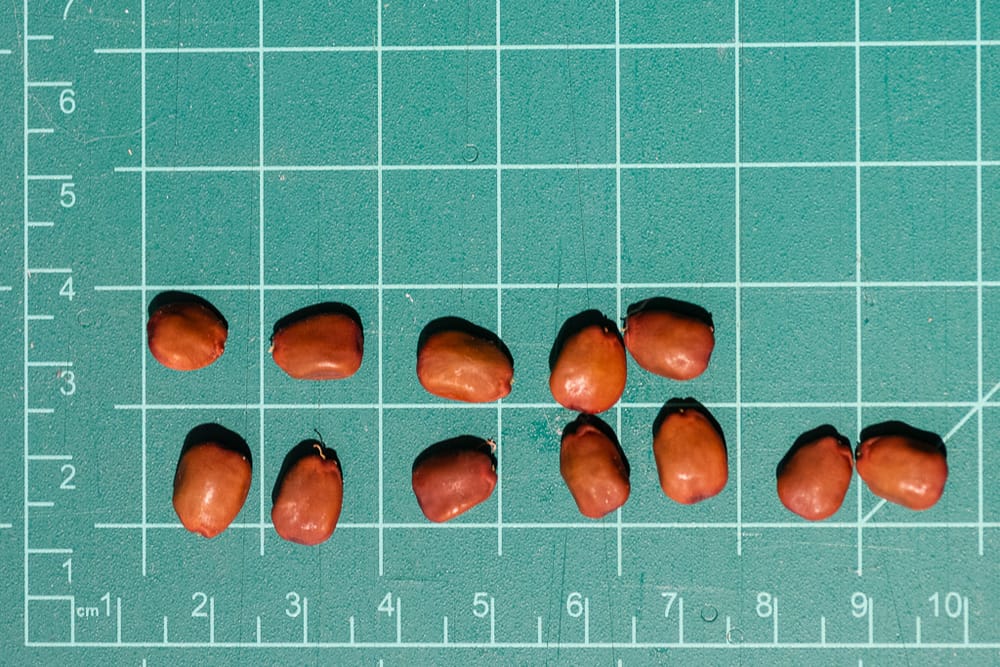
I got a small bag of 11 pods, and then rather messily extracted the seeds. The hulls were stiff and mostly try, but had a bit of stickiness to them like dried fruit. It also smells faintly like some kind of dried fruit, though I can't quite place it with a cold stuffing up my nose. The seeds themselves are hard and light, like a smaller coffee bean.
Extracting the seeds was initially tedious since I had to essentially rip the pods apart carefully to make sure I didn't damage the seeds. Towards the end when I learned how durable they were, it was easier to split the pod carefully with a knife and break it up that way.
Next, I took out the cheap gem scale I have and weighed everything that came out of the pod, you can see the data below. I highlighted the abnormally low values in red. From research I've read, the weight of the seeds scales linearly with the volume, so you can spot the extra light ones without any trouble. You can easily spot the lighter seeds in the photo above

You can see that there's a decent amount of variation within the individual pods. W/ a standard deviation of 0.02-0.05 grams. which amounts to 10-25% of the modern standard of 0.2g.

That said, you can see in the histogram that a lot of seeds actually fall within a narrow range of weights, 0.18 to 0.25. And since it's very easy to pick out the extra small ones, I did and weighed everything together. For a sample of 100 seeds, the average weight was 0.2157 grams. That'd be close to a 8% difference above the official definition.
It might be possible to hand sort out a set of seeds that were all very similar in size and thus weight. This injects human subjectivity into the standard, but since most of the seeds to cluster around a similar weight area, it's not to hard to get a pile of beans and sort out all the ones that look too big or small. I tried to do this by separating out obviously big ones with ones that looked small or weird and the biggest pile of seeds averaged 0.218g, so a 9% difference from the standard. I guess this particular carob farm's trees just tended to have overly fat seeds... (or my scale is off).

Luckily, I don't have to rely on my own work! Some researchers in Europe asked the exact same questions in a 2006 paper "Seed size variability: from carob to carats", linked below.
 *Author for correspondence (lindsaytuwinst.unizh.ch)
The authors are much more familiar with things like seed weight distributions than I am, and so they are able to make the claim that carob seeds actually do not have less variability in weights than other seeds.
The trees studied grew in various place in Europe, not California like mine had, and they found this:
The average mass of seeds from female trees (200.5±2.47 mg) was very close to the metric carat (200 mg) while seeds from hermaphrodite trees were lighter (175.8±7.1 mg) possibly reflecting the cost of pollen production (figure 2a). However, average seed mass was unaffected by the age or size of the trees (mixed effects ANOVA; age: F1,26=0.7, p=0.406; size: F1,26=0.1, p=0.704)
The authors also ran a study where they showed participants two images of seeds that averaged 200mg, and asked them to pick the heavier one. The participants were able to reliably pick the heavier seed when the variation between the two seeds was 10%.
So the author's explanation for the myth of the carob seed being unusually consistent in weight despite the variation of weights being normal between trees and within the individual pods is because humans were selecting out "bad" seeds. Since most seeds cluster very closely together, it shouldn't be difficult for any human to take a bag of even a few hundred seeds and pick out a selection of "the most typical ones" to use as a weight standard. The authors note that the international standards for the carat before the final standardization in metric only had a coefficient of variation of 3.6% compared to their 34% in their sample (and 18% in mine).
Maybe some other time in the future, I should buy some barleycorn and wheat grains just to see how those seeds have shifted from the standards that used to be grounded in them.
Standing offer: If you created something and would like me to review or share it w/ the data community — just email me by replying to the newsletter emails.
Guest posts: If you’re interested in writing something, a data-related post to either show off work, share an experience, or want help coming up with a topic, please contact me. You don’t need any special credentials or credibility to do so.
"Data People Writing Stuff" webring: Welcomes anyone with a personal site/blog/newsletter/book/etc that is relevant to the data community.
About this newsletter
I’m Randy Au, Quantitative UX researcher, former data analyst, and general-purpose data and tech nerd. Counting Stuff is a weekly newsletter about the less-than-sexy aspects of data science, UX research and tech. With some excursions into other fun topics.
All photos/drawings used are taken/created by Randy unless otherwise credited.
- randyau.com — homepage, contact info, etc.
Supporting the newsletter
All Tuesday posts to Counting Stuff are always free. The newsletter is self hosted. Support from subscribers is what makes everything possible. If you love the content, consider doing any of the following ways to support the newsletter:
- Consider a paid subscription – the self-hosted server/email infra is 100% funded via subscriptions, get access to the subscriber's area in the top nav of the site too
- Send a one time tip (feel free to change the amount)
- Share posts you like with other people!
- Join the Approaching Significance Discord — where data folk hang out and can talk a bit about data, and a bit about everything else. Randy moderates the discord. We keep a chill vibe.
- Get merch! If shirts and stickers are more your style — There’s a survivorship bias shirt!