
Daylight savings broke software (again) and other Time News!
Yay, an excuse to write about time!
It's been a while since an opportunity came up. Over the weekend, daylight savings time in the US kicked in, starting the annual debates about abolishing DST, the news that British Columbia has declared this to be their last DST jump, and also the utter chaos as people in the UK and EU don't get their respective versions of summer time for another few weeks and cross-country meeting invites may be at completely the wrong times unless the "home timezone" of the meeting is set "correctly".
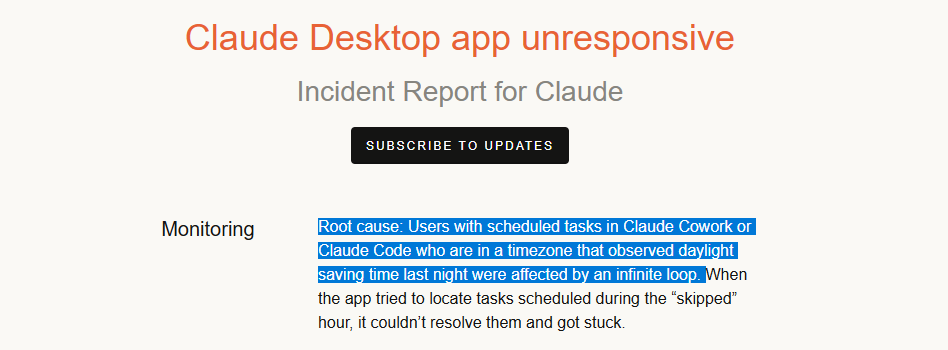
Oh, and Claude apparently broke thanks to daylight savings time.
Apparently when scheduled tasks were set at some time in 2AM period and clocks skipped from 1:59AM to 3:00AM, the code freaked out and went into an infinite loop.
Thing is, you don't really hear all that much about computer errors that happen due to daylight savings time. I tried looking for more examples from this weekend and couldn't find anything. At the least, nothing that made the news or hit the Google index within a day. They happen multiple times a year, to multiple people, to enough of a population size that most of the obvious issues would've been discovered long ago.
Moreover, I think most software folks are at least aware enough of daylight savings issues that they normally use a timescale that doesn't involve a DST shift. Often it's the ubiquitous UTC or unixtime which are "free" to use in the sense that most programming languages and APIs default to using those whenever timezones aren't referenced. It's only when you have to do things in local time, like for a "cronjob wrapped in an AI bill" thing that you have to us local time as a production parameter.
OK. There's not much more to harp about DST. So make sure to check your localtime code out there!.
The Earth is still spinning faster, but less so
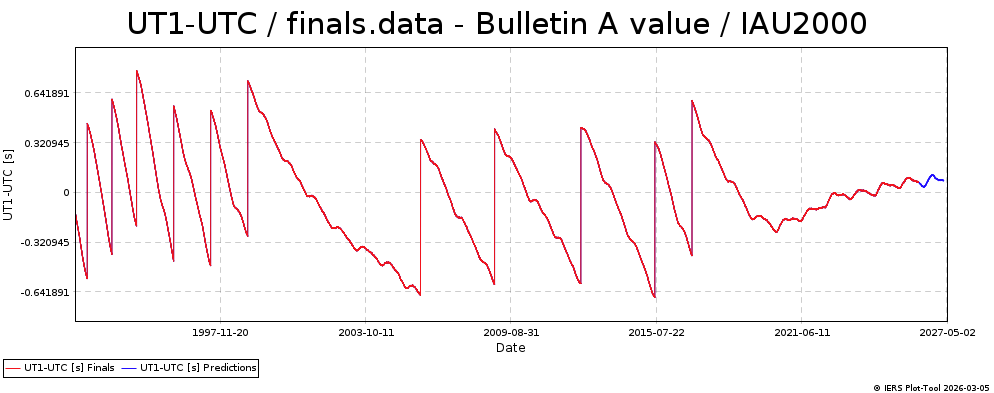
I still check in on this every couple of seasons because I find it fascinating. For more details you can catch up on a previous post at Uh oh, the Earth *continues* to spin faster. The gist is that the Earth's rotational speed is still increasing (hence the above chart UT1-UTC is trending upwards). Normally the chart should be steadily going downwards before resetting in those big vertical jumps where a leap second was injected into UTC. But since about 2020, things the trend reversed for as-yet unknown reasons (probably related to climate change shifting mass around).
The original worry was that if things kept speeding up enough, we'd theoretically need a negative leap second to account for it. But given that eyeballing the chart we're only about 0.3 seconds faster now than when it started reversing, we were a long ways away from that point no matter what. Now that the trend is apparently leveling off for the next year or so, maybe the chances were never very likely to begin with.
But we don't even have to worry about THAT now because, in 2022 the General Conference on Weights and Measures voted to move towards abolishing leap seconds by 2035 or earlier by allowing the gap between UT1-UTC to exceed the current 1 second to something bigger (to be defined later by 2035). There's some other international bodies involved in the whole setup and so movement in this space takes years. Until everyone agrees what the difference between UT1 and UTC is allowed to be, leap seconds are technically still on the table, which is why the IERS announced that there wasn't going to be a leap second for early 2026.
Oh, and power outages messed w/ US atomic time for a bit
Another interesting time thing happened a couple of months back when Boulder had a big storm that knocked power out for an extended period. The power disruption apparently affected the NIST campus starting Dec 17 ~22:23UTC. There's posts to a NIST mailing list about the outage.
Since running the multiple atomic clocks needed to maintain the standard requires significant cooling, and thus power, they ran out of generator power during the event. After two days generators started failing, and they announced there were issues affecting the clocks, which news sources like NPR picked up on.
Later, staff at the campus managed to get more generators and stabilize the temperature controls, so the clocks went out of sync roughly 5 microseconds. Even that deviation was something like 5000x worse than what the campus can usually provide. The final update of the incident mentioned that by Dec 22nd, they had re-synced the clocks to UTC back to within a few nanoseconds (which is the usual operating range) with the help of a backup time scale at NIST Boulder. Their conclusion was that the max 5 microsecond deviation they saw was still significantly less than the roughly 1 millisecond uncertainty of NTP time distribution, "we can say in retrospect that the accuracy of the Internet Time Service was not compromised and that users were not impacted by the time deviation."
So... technically the big power outage did mess with the atomic time standard... but not enough that NTP consumers were affected. Supposedly advanced experiments that somehow uses those clocks on a more precise basis might have been affected?
They're working on updating the SI second definition
So, the world of time metrology has apparently made advances that go right over my head, but I've been seeing talk of "Strontium clocks", technically a version of a optical lattice clock. Over time, the optical lattice clocks have been improving to the point where they have become far better than more traditional cesium clocks that currently define the SI second.
But the weird problem is that since ~2007, when optical lattice clocks started beating cesium clocks, it's not possible to measure performance against the second because the second was tied to the cesium clocks. The analogy is that the ruler used to measure how clocks were doing (10-16 resolution) didn't have fine enough markings to compare against the newer 10-18 - 10-19 resolutions. The best these new clocks can do with the current definition of the SI second is to compare against other clocks in a ratio to show that they're ticking more accurately.
Anyways, the CGPM adopted a draft resolution (see resolution B) on updating the SI second by 2030.
Anyways, there's talk about how they plan on realizing the second with newer designs of clocks linked below. It goes over some interesting (to me?) aspects about how there's different candidates for what process they will choose to do, the various pros and cons they have to juggle when considering them.
Look, working in tech, the idea of slow, considered, durable decisions based on research is an aspiration at best, so watching people do it for reals is pretty interesting.
Standing offer: If you created something and would like me to review or share it w/ the data community — just email me by replying to the newsletter emails.
Guest posts: If you’re interested in writing something, a data-related post to either show off work, share an experience, or want help coming up with a topic, please contact me. You don’t need any special credentials or credibility to do so.
"Data People Writing Stuff" webring: Welcomes anyone with a personal site/blog/newsletter/book/etc that is relevant to the data community.
About this newsletter
I’m Randy Au, Quantitative UX researcher, former data analyst, and general-purpose data and tech nerd. Counting Stuff is a weekly newsletter about the less-than-sexy aspects of data science, UX research and tech. With some excursions into other fun topics.
All photos/drawings used are taken/created by Randy unless otherwise credited.
- randyau.com — homepage, contact info, etc.
Supporting the newsletter
All Tuesday posts to Counting Stuff are always free. The newsletter is self hosted. Support from subscribers is what makes everything possible. If you love the content, consider doing any of the following ways to support the newsletter:
- Consider a paid subscription – the self-hosted server/email infra is 100% funded via subscriptions, get access to the subscriber's area in the top nav of the site too
- Send a one time tip (feel free to change the amount)
- Share posts you like with other people!
- Join the Approaching Significance Discord — where data folk hang out and can talk a bit about data, and a bit about everything else. Randy moderates the discord. We keep a chill vibe.
- Get merch! If shirts and stickers are more your style — There’s a survivorship bias shirt!